How to Improve Search Results When AI Takes the First Click
May 28, 2026
Person working at a desk with dual monitors showing dashboards, in a bright office with a laptop and coffee mug.


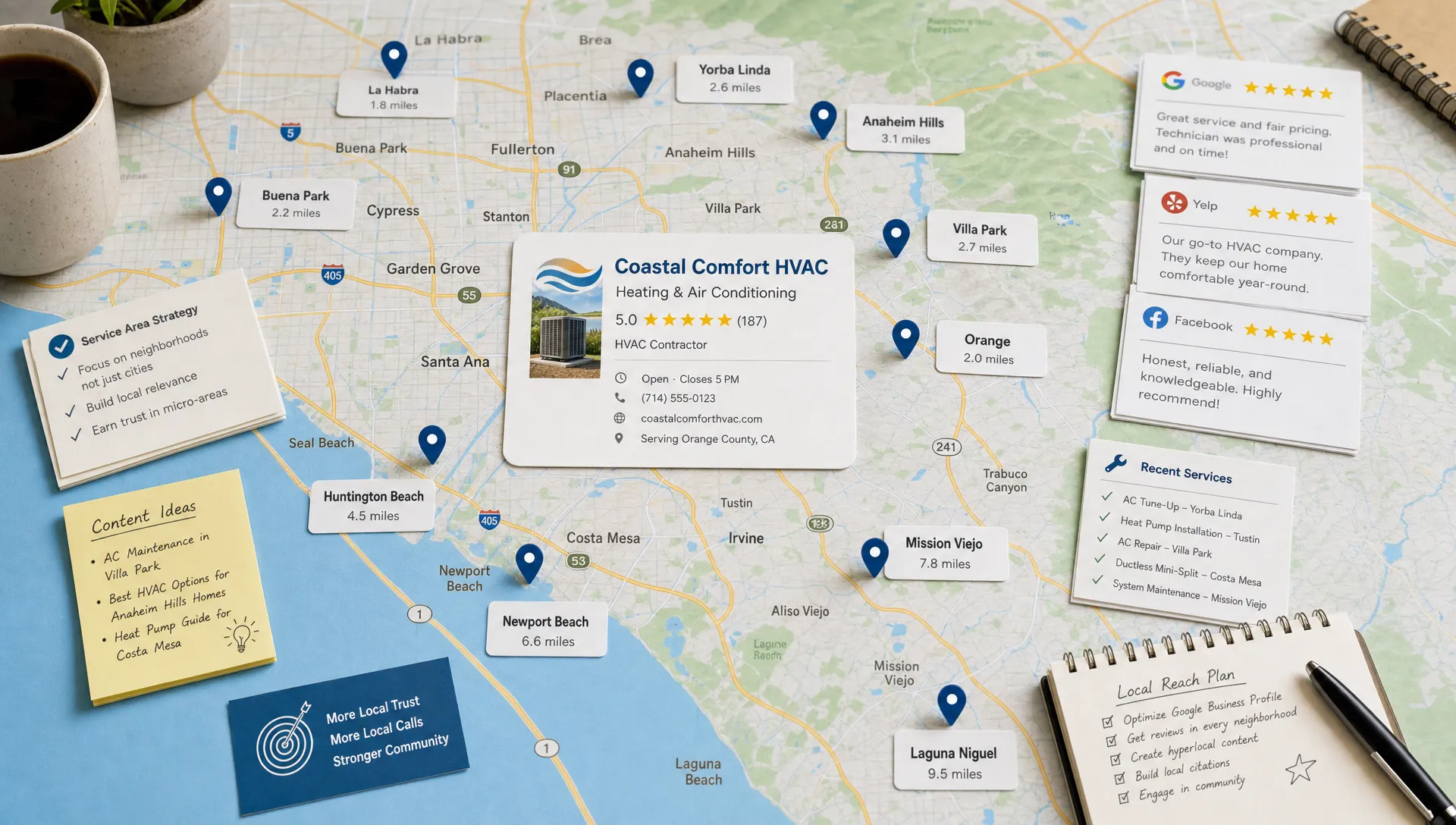
When AI summarizes a search before a customer clicks, the old playbook of ranking a single web page is no longer enough. For Orange County contractors, multi-location medical practices, dental groups, law firms, and California service brands, improving search results now means becoming the trusted source that AI, maps, voice assistants, and human searchers can all understand.


That shift does not make SEO irrelevant. It makes clarity, authority, and conversion more important. If a homeowner in Irvine asks Google for the best HVAC repair company, or a patient in San Jose asks an AI assistant which dental office handles emergency appointments, the business that wins is usually the one with the clearest local entity signals, strongest proof, and most answer-ready content.


Search results are no longer just links


Traditional search results were mostly a list of pages. Today, search results are a layered answer environment. A single local query can trigger an AI Overview, map pack, Google Business Profile, paid listing, review snippet, video result, directory listing, and organic page, sometimes all on the same screen.


For local businesses, this creates a strange situation. You may still be visible, but the customer may not click your website. They might call from Google Maps, ask a follow-up question inside an AI tool, compare reviews without leaving the results page, or use voice search to choose one provider.


That is why the goal has changed from getting the click to being selected as the answer. The click still matters, but it is no longer the only measurable win.


Google’s own guidance on structured data explains that machine-readable markup helps search engines understand page content and qualify it for enhanced search features. For local rankings, Google also states that relevance, distance, and prominence influence visibility. Those same concepts matter even more when AI systems decide which businesses are worth summarizing, citing, or recommending.


Start by diagnosing where your search results are breaking down


Before you rewrite pages or publish more blogs, look at the full customer journey. The problem may not be that your business is invisible. It may be that AI tools do not understand your service area, Google does not trust your local prominence, or searchers do not see enough proof to call.


Run searches the way your buyers actually talk. A roofer in Huntington Beach should test queries like roof leak repair after rain, best flat roof contractor near Huntington Harbor, and emergency roof tarping Huntington Beach. A dental group in Sacramento should test emergency dentist open today, dental implants near Midtown Sacramento, and pediatric dentist accepting new patients.


Do this across Google Search, Google Maps, voice search, ChatGPT, Perplexity, and Gemini. Document what appears, who is cited, which competitors show up repeatedly, and whether your business appears as a confident recommendation or just another link.


SEO Comparison Table
Old SEO question Better AI-era question
Do we rank on page one? Are we being cited, summarized, or recommended?
Did organic traffic increase? Did calls, form fills, direction requests, and booked appointments increase?
Do we have enough keywords? Does every page clearly explain who we serve, where we serve, and why we are credible?
Do we have blog content? Do we answer the exact questions customers ask before hiring?
Do we have backlinks? Do we have trusted local proof across multiple authoritative sources?


This audit often reveals the real issue. Many businesses have pages that humans can interpret, but AI systems see vague claims, thin service descriptions, inconsistent location data, and weak proof.


Make your business entity impossible to misunderstand


AI search depends heavily on entity understanding. In plain English, an entity is a recognizable thing, such as your company, your founder, your service category, your location, your reviews, and your relationship to other trusted sources.


For a California contractor or professional practice, entity clarity should answer four questions everywhere your brand appears:


  • What services do you provide?
  • Which cities, neighborhoods, or counties do you serve?
  • Who is responsible for the business?
  • What evidence proves you are credible?


Your website, Google Business Profile, citations, social profiles, review platforms, and local content should all reinforce the same facts. If one listing says Laguna Beach, another says Orange County, another says Southern California, and your website buries service areas in a footer, AI systems may not confidently connect your business to local intent.


The fix is not keyword stuffing. The fix is consistency. Use the same business name, address, phone number, service categories, city references, and professional credentials across your most important digital assets.


For example, Kell Web Solutions is based in Laguna Beach and Laguna Niguel, serves Orange County, and works with California businesses that depend on local visibility. That relationship between brand, service, geography, and expertise needs to be repeated naturally across core pages, supporting content, and external references.


Build answer-first service pages


A service page should not read like a brochure. It should work like a decision page for both humans and answer engines.


When a homeowner lands on a plumbing page, they want to know whether you solve their specific problem, serve their neighborhood, have proof, and can respond quickly. AI systems look for similar signals, but they also need structure.


A strong answer-first service page includes a concise opening answer, clear service scope, local relevance, proof, FAQs, internal links, schema markup, and a conversion path. The goal is to remove ambiguity.


Page Elements Optimization Table
Page element Why it improves search results
Direct answer near the top Helps AI and users understand the page immediately
Specific service details Matches high-intent searches more accurately
Local service area language Connects the page to city and neighborhood intent
Reviews, examples, or credentials Builds trust and reinforces prominence
FAQ section Captures conversational and voice-style queries
LocalBusiness, Service, and FAQ schema where appropriate Gives search engines structured context
Clear call button or booking path Converts demand even when clicks are limited


A page about emergency HVAC repair in Irvine should not simply say you offer quality HVAC services. It should answer questions like how fast service is available, what systems are repaired, which neighborhoods are covered, what warning signs require urgent attention, and why local homeowners trust the company.


That is the difference between content written for rankings and content written to become the answer.


Expand from city SEO to hyperlocal authority


Most local businesses say they serve an entire county. AI search is more precise than that. It often responds to neighborhood, landmark, suburb, and near-me intent.


In Orange County, a contractor may need visibility in Laguna Beach, Newport Beach, Irvine, Anaheim, Huntington Beach, Costa Mesa, Mission Viejo, and Santa Ana. In Northern California, a practice may need separate authority around San Jose, Fremont, Sunnyvale, Oakland, and San Francisco. In Central and Inland California, local intent may cluster around Sacramento, Fresno, Bakersfield, Stockton, Riverside, San Bernardino, and Ontario.


The mistake is creating dozens of thin city pages with swapped-out city names. That approach looks weak to users and unhelpful to search engines.


A better approach is to create genuinely useful local assets. Each location page or supporting article should include local service considerations, neighborhood-specific questions, proof from nearby customers, relevant regulations or conditions, and a clear reason the page exists.


This is where distributed authority becomes powerful. A single website can rank, but a network of accurate, useful, locally aligned assets can create stronger entity signals. Kell Web Solutions’ Hyperlocal Authority Builder is designed around this idea, especially for contractors and service businesses that need to surround a city with trustworthy local signals.


You can see the same principle outside California. A local service business like professional street sweeping services in Nashville, TN makes its relevance easier to understand by clearly tying services, property types, compliance needs, and service geography together. Whether the market is Nashville, Newport Beach, or San Jose, local clarity helps both searchers and machines determine fit.


Strengthen Google Business Profile and off-site proof


When AI takes the first click, off-site proof becomes even more valuable. Google Business Profile, reviews, citations, directories, local media, chamber pages, industry associations, and social profiles all help search systems validate that your business exists, serves the area, and deserves attention.


For local contractors and multi-location practices, your Google Business Profile should be treated like a revenue asset, not a basic listing. Service categories, service areas, photos, products or services, appointment links, posts, Q&A, and review responses all contribute to customer confidence.


Reviews are especially important because they provide third-party language about your services. If customers repeatedly mention emergency repair, clean installation, same-day response, specific cities, or staff names, those phrases become natural proof of what your business is known for.


Do not fabricate reviews or over-script customers. Instead, ask for specific, honest feedback after completed work. A good review request might ask what problem was solved, which city the customer is in, and what made the experience helpful. That creates richer signals without manipulating the customer.


Publish content that answers real buying questions


AI search favors content that directly satisfies intent. For local businesses, the best content often comes from sales calls, customer objections, technician notes, intake forms, and reviews.


Contractors should answer questions like:


  • How much does this repair usually cost in our region?
  • When is replacement smarter than repair?
  • What should a homeowner do before calling?
  • Which permits, codes, or HOA rules may apply?
  • What problems are common in this city because of weather, building age, or property type?


Professional practices should answer questions like:


  • Who is a good candidate for this service?
  • What happens during the first appointment?
  • What documents should a client or patient bring?
  • Which locations are accepting new appointments?
  • What makes this provider different from a generalist?


The most useful pages sound like an expert explaining the answer to a real customer. Avoid bloated introductions, vague claims, and generic AI-written paragraphs. Include practical detail, local context, and clear next steps.


If you serve multiple cities, use content to support the full local journey. A roofing company in Orange County might publish seasonal content about coastal moisture in Laguna Beach, tile roof issues in Irvine, flat roof maintenance in Anaheim, and storm preparation in Huntington Beach. A legal firm could publish location-specific guides for clients in Los Angeles, San Diego, San Jose, and Sacramento.


Use structured data, but do not treat schema as magic


Schema markup helps search engines interpret your content, but it cannot rescue weak content. Think of schema as a label, not the product itself.


Useful schema types for local service businesses may include LocalBusiness, Organization, Service, FAQPage, Review, BreadcrumbList, and Article, depending on the page and whether the visible content supports the markup. The key is accuracy. Do not mark up fake reviews, invisible FAQs, or services you do not actually provide.


Also make sure your technical foundation is clean. AI crawlers and search engines need accessible pages, fast load times, logical internal links, indexable content, and clear headings. If important service information is trapped in images, hidden tabs, broken scripts, or inconsistent navigation, it may not be understood.


For businesses preparing for answer engines, Kell Web Solutions’ Answer Engine Optimization service focuses on making digital presence easier for AI-driven platforms to understand, trust, and recommend.
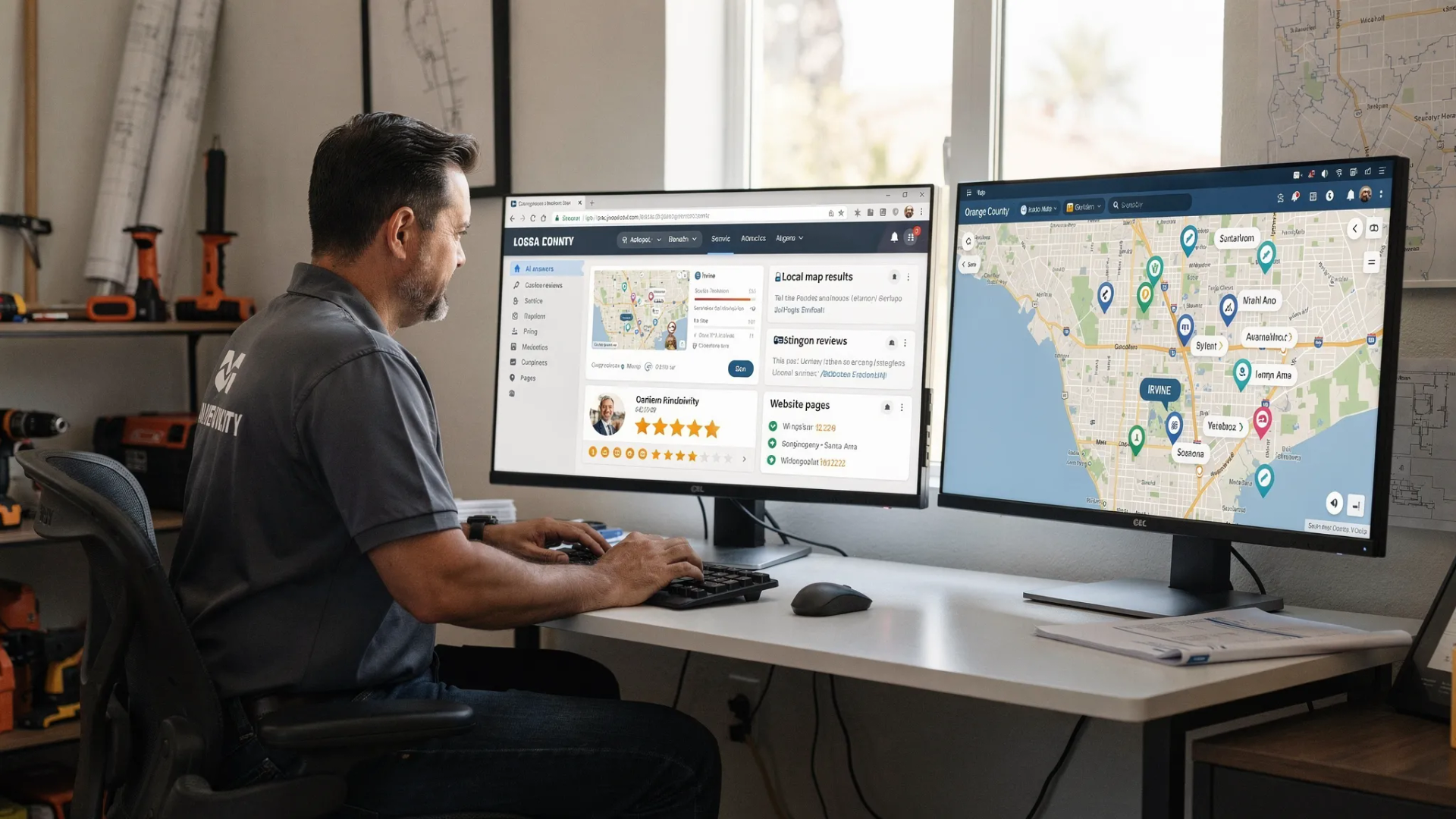

Man working at a desk with dual monitors, one showing a dashboard and the other a map.

Improve conversion because fewer clicks must work harder


If AI reduces website visits, every remaining visit is more valuable. The businesses that win in 2026 will not only improve search results, they will convert attention faster.


That means your website should make the next step obvious. Phone numbers should be tappable on mobile. Contact forms should be short. Appointment links should be easy to find. Service pages should include trust signals near the call to action. If you serve emergencies, the page should make response expectations clear.


For contractors, missed calls are often missed revenue. A homeowner with a leaking pipe, broken AC system, or electrical issue is unlikely to leave multiple voicemails and wait patiently. For professional practices, slow follow-up can send a qualified patient or client to the next provider in the search results.


This is why SEO, AEO, local visibility, and lead handling must work together. Kell Web Solutions’ Profit Accelerator addresses the outreach and booking side of growth, while Local SEO Mastery supports the foundational visibility layer.


A practical 30-day plan to improve search results in the AI era


You do not need to rebuild everything at once. Start with the pages and profiles closest to revenue.


SEO Action Timeline Table
Timeline Priority Action
Days 1-7 Visibility audit Test buyer questions across Google, Maps, AI tools, and voice search. Record where you appear and where competitors win.
Days 8-14 Entity cleanup Align business name, phone, address, service areas, categories, and descriptions across core profiles and citations.
Days 15-21 Core page improvement Rewrite top service pages with direct answers, local proof, FAQs, internal links, and clear calls to action.
Days 22-26 Structured data and technical cleanup Add accurate schema, improve mobile speed, fix indexing issues, and make important content crawlable.
Days 27-30 Proof and measurement Request detailed reviews, update Google Business Profile, track calls and forms, and choose the next content cluster.


After the first month, expand into location-specific authority. Build the pages, articles, reviews, and off-site signals that prove your business is relevant in each priority market. For many California businesses, that means starting with Orange County, then expanding into Los Angeles, San Diego, San Jose, Sacramento, Fresno, Riverside, and other high-value service areas.


What to measure when clicks are no longer enough


Organic traffic still matters, but it is incomplete. If AI answers reduce clicks while calls increase, traffic alone may make your marketing look worse even when revenue improves.


Track metrics that reflect how customers actually choose you:


  • AI citations and mentions in answer engines
  • Google Business Profile calls, direction requests, and website clicks
  • Local pack rankings for priority service and city combinations
  • Form submissions, booked calls, and appointment quality
  • Review quantity, review quality, and review velocity
  • Conversion rate by service page and location page
  • Share of answer against key competitors


The right dashboard should connect visibility to revenue. A contractor does not need vanity traffic from people outside the service area. A dental group does not need impressions for services it does not offer. The best search results are the ones that produce qualified conversations.


Frequently Asked Questions


Can SEO still work when AI answers the question first? Yes. SEO still matters, but it must evolve. Your content needs to be structured, credible, local, and easy for AI systems to interpret. The goal is not only to rank, but to be cited, summarized, and trusted.


What is the difference between SEO and Answer Engine Optimization? SEO focuses on improving visibility in traditional search rankings. Answer Engine Optimization focuses on making your business understandable and trustworthy enough to be selected by AI results, voice assistants, and answer engines.


Do local businesses need separate pages for every city they serve? Not always. Create separate pages only when you can make them genuinely useful and locally specific. Thin duplicate city pages can weaken trust. Strong local pages should include real service details, proof, FAQs, and unique context.


How long does it take to improve AI search visibility? Foundational improvements can happen in weeks, especially for entity cleanup, service page structure, and Google Business Profile updates. Stronger authority signals usually compound over several months as content, reviews, citations, and local proof grow.


Is schema markup enough to win AI search results? No. Schema helps search engines understand content, but it must reflect accurate, visible, high-quality information. Strong pages, consistent entities, reviews, local authority, and technical accessibility all matter.


What should Orange County contractors prioritize first? Start with your highest-value services and highest-value cities. For many contractors, that means improving emergency service pages, Google Business Profile, review generation, and local content for cities like Irvine, Newport Beach, Laguna Beach, Anaheim, and Huntington Beach.


Turn AI disruption into local search advantage


AI may take the first click, but it does not have to take your next customer. The businesses that win will be the ones that make their expertise, service areas, proof, and conversion paths unmistakably clear.


Kell Web Solutions helps Orange County and California businesses adapt to this new search environment with Answer Engine Optimization, Local SEO, Hyperlocal Authority Builder, and revenue-focused growth systems. If your search results are producing fewer clicks, fewer calls, or less predictable demand, now is the time to rebuild your visibility for the way customers actually search.


Book a strategy call with Kell Web Solutions to identify where AI is intercepting demand and how to become the answer customers choose.

August 21, 2026
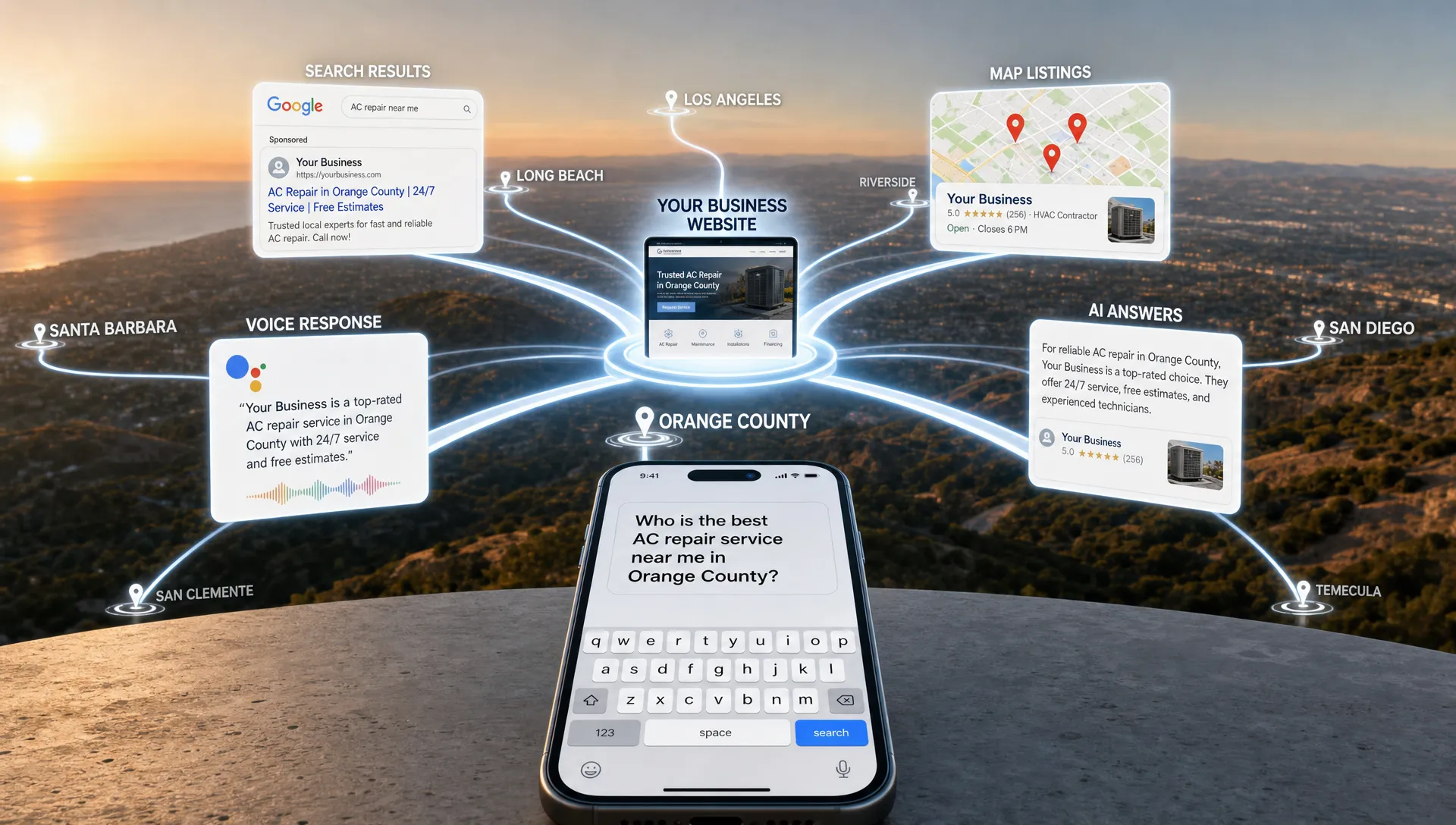
 Is your website invisible to the AI your prospective clients are using to vet you? It's a fair question, and most Orange County business owners can't answer it. They've never actually asked ChatGPT or Perplexity what it says about their firm. Search used to mean links you could rank. Now it's a conversation, and AI decides who gets mentioned. G2's newest B2B buyer research found 51% of B2B buyers now start with AI chatbots, not Google. That's up from just 29% eleven months earlier — a massive swing in under a year. This isn't a fringe prediction anymore. Gartner projects that traditional search volume will drop 25% by 2026. That decline comes directly from AI chatbots replacing search queries. Gartner calls these tools "substitute answer engines." That shift didn't stay contained to software. Agencies, law firms, and medical practices are now researched by AI before a human ever visits. If you're not part of that conversation, you're not just losing clicks. You're losing the mention entirely. Owners in this position usually notice the symptom before they understand the cause. Referral volume looks fine, the website still gets occasional traffic, but new inbound inquiries have quietly slowed. That's often the first sign the AI conversation about your category is already happening — without you in it. This matters more for B2B and professional service firms than most businesses. Home services companies can still win a call through pure proximity. A law firm or consultancy has no such fallback once an AI shortlist forms without them. The gap between having a website and being an answer "Most OC businesses are losing leads because their brand is missing from AI-generated 'best-of' lists and conversational search results. We bridge the gap between their website and the LLM's understanding of their authority." — Gregg Kell, Founder, Kell Web Solutions There's a specific failure behind that quote, and it deserves a name. Call it the AI citation authority gap. It's the distance between what your website says about your firm and what a model actually believes. That belief surfaces the moment a prospect actually asks. A website is a document. An AI answer is a judgment. Google could always be tricked with the right keywords in the right places. Answer engines don't work that way. They synthesize an opinion from everything they can find about you. Then they decide whether you're worth mentioning by name. That's a much higher bar than ranking. Most Orange County B2B firms have never been measured against it. Nobody built a scorecard for this until recently. What AI platforms actually reward HubSpot's 2026 AEO research frames AI citation as consensus, not ranking. Answer engines don't crawl your site and stop. They cross-reference it against everything else they can find. That includes directories, review platforms, press mentions, and forums. Then they look for agreement across all of it. Entity consistency matters most. Does your name, address, pricing, and services match everywhere online? Inconsistent facts across your site and listings suppress citations. Structured content matters second. Clear headers and schema markup help a model extract facts accurately. Direct, answer-first writing helps too. Third is agentic readiness. That means machine-readable infrastructure like llms.txt and JSON-LD. It tells an AI crawler exactly who you are, instead of making it guess. Here's the uncomfortable part. A page outside Google's top five can still win the AI answer. That happens whenever it most directly answers what the user asked. Ranking and citation are no longer the same contest. Firms optimized purely for the old contest are flying blind in the new one. Prompts to AI look nothing like old search queries. That same research found average ChatGPT prompts run 23 words long. A typical Google search is just 3.37 words. Five signs your firm already has a citation authority gap Most owners can self-diagnose this in about ten minutes, before spending a dollar on any agency. A few patterns show up again and again among Orange County B2B and professional service firms that haven't looked yet. You've never checked. You've never typed your own category and city into ChatGPT to see who it names instead of you. Most owners assume they'd show up — most haven't checked. Your NAP data doesn't match. Name, phone, address, and services should read identically across your site, your GBP, and directories. No schema markup. Your site has no structured data, so a model has to guess facts it could otherwise extract with certainty. Thin third-party proof. Your only credibility signal is a handful of Google reviews — no press coverage, comparison articles, or industry citations backing you up. A competitor got there first. If a rival has invested in AEO and you haven't, the model already picked a side. It will keep recommending that side until your signals catch up. Any single one of these is fixable in an afternoon. Stacked together, they're what quietly kills a shortlist spot. None of these five signs require expensive tools. They require ten honest minutes and a willingness to look. See your firm the way a machine sees it, not the way you'd describe it. Why this hits professional service firms harder Home services businesses feel this shift through missed emergency calls. B2B and professional service firms feel it earlier — in the shortlist itself. That happens well before a prospect ever picks up the phone. Orange County agencies are already repositioning around this This shift isn't hypothetical in Orange County. Costa Mesa-based Intero Digital now sells a named "GEO" service. Irvine's Directive Consulting markets its own "DiscoverabilityOS" platform for exactly this problem. Neither is warning you the shift is coming. Both are already selling the fix to whoever notices first. That's the real cost of waiting to check your own visibility. Kell is positioned differently from both of them. AEO isn't a bolted-on service line here — it's the whole business. That focus is a meaningful difference in this comparison. Forrester's Buyers' Journey research found 92% of B2B buyers start with a vendor already in mind. 41% already have one preferred vendor before formal evaluation even begins. That preference used to form through referrals and conference badges. Now it increasingly forms through a five-second exchange with a chatbot. That compression makes the gap dangerous for OC's B2B and professional firms. Legal, accounting, consulting, and marketing firms sell trust before anything else. So do multi-location medical and dental practices. A prospect might ask an AI model, "Who's the best marketing agency in Orange County?" The model vouches for whichever firm it can verify, not necessarily the one that deserves it most. Picture a mid-size Irvine consulting firm with twenty years of results. Its website is a static page with no structured data. A three-year-old competitor next door has clean schema and real press mentions. Today, the newer firm is more likely to get named. Track record stopped being self-evident once AI started making the introductions. The risk compounds because AI doesn't just fail to mention you. It actively promotes whoever it trusts instead — often a competitor you didn't know was in the running. A 680-million-citation analysis found 73% of B2B buyers now use AI tools like ChatGPT and Perplexity. Yet only 22% of marketers track how their brand shows up. That 51-point spread is the citation authority gap, measured industry-wide. Every mention has a winner and a loser The G2 research above carries a second finding worth sitting with. Sixty-nine percent of B2B buyers switched vendors based on what a chatbot recommended. A third bought from a vendor they'd never heard of before. Read that again as a business owner, not a marketer. Every AI-driven recommendation is a zero-sum event. When a model can't verify your firm, it doesn't leave the answer blank. It cites the competitor whose signals were clear enough to trust. You don't just miss a lead — you hand it over. You hand it to whoever closed their own authority gap first. Trust signals matter here too. In the same G2 survey, 45% of buyers trusted review-site citations most. AEO isn't just a website exercise — it's an off-site reputation audit. Professional service firms have their own version of this signal. Certifications, bar admissions, and awards belong in structured markup, not just a page footer. A model can't cite credentials it can't parse. Multi-location medical, dental, and legal practices face an extra layer here. A model asked about a specific neighborhood has to pick one location to name. Practices with one strong "flagship" listing often lose their satellite offices. Those locations vanish from AI answers even when service quality is identical. Where to start if you want to check this yourself Before hiring anyone, run this audit yourself. Open ChatGPT and Perplexity and ask what a prospect would ask. Try your service, your city, and "who's the best." Read the answer closely. Note whether you appear, how you're described, and who appears instead. Next, pull up your Google Business Profile and your website's contact page. Add any directory listing you can find. Compare all three, line by line. From there, HubSpot's schema markup guide is a solid starting point. It adds the structured data most answer engines look for. It won't close the full gap alone, but it's the baseline everything else builds on. This isn't a one-time fix, either. Entity signals drift as directories update and content ages. Most firms recheck this audit every quarter. Closing the gap: what becoming an AI-cited authority actually requires Kell Web Solutions built its AEO service around exactly this problem. It's the same shift founder Gregg Kell has tracked for two decades in Orange County. The goal isn't to chase another ranking algorithm. It's to become the entity an AI model trusts enough to name. Kell's philosophy leans into durability on purpose. The goal is compounding authority, not a short-term ranking spike. Spikes fade the moment an algorithm updates — entities don't. Founder Gregg Kell wrote a book on exactly this problem. It's called "The Invisible Expert," and it's downloadable from Kell's site. That background shapes the whole AEO methodology. That work breaks into three outcomes worth understanding first. First, recognition: AI platforms need to identify your firm as an authority. Not a generic entry in a directory. Second, citation: earning a real mention when a prospect asks a local question. That's the exact moment an AI model is trying to answer. Third, protection: building signals strong enough that competitors can't quietly displace you. That displacement often happens in a recommendation you never see. Kell's AEO service runs a five-step process to get there. It maps how customers phrase questions, then audits current AI visibility. From there it restructures the site and builds durable authority signals. It's sold in three tiers, from AEO Essentials up through AEO Elite . Elite layers in advanced schema and full agentic-readiness infrastructure. Pricing here is published, not hidden behind a "contact us" form. AEO Essentials starts at $500 setup plus $500 a month. AEO Elite runs $1,000 setup plus $2,500 a month. Multi-location practices often pair that work with Local SEO Mastery. It keeps every branch's citation data consistent — the exact weak point above. It's smaller and more foundational, and it often comes first. Scale is deliberately part of the pitch, too. Larger agencies often bolt AI-search language onto existing SEO retainers. They tend to route clients to account teams instead of founders. Kell stays boutique on purpose. AEO clients work directly with founders Gregg and Debbie Kell. That's a real difference while the strategy is still evolving monthly. Kell also integrates with GetAiRefs' Share of Answer scoring. That measures how often a client is actually cited across target queries. It turns "are we visible to AI" from a guess into a tracked number. For more on how the click itself is changing, see Kell's piece on when AI takes the click . None of this replaces good client work or a strong reputation. It translates that reputation into a form AI platforms can verify. Then it repeats that back to a prospect who's never heard of you. What it looks like when the gap closes Closing this gap looks different from a typical SEO win. Rankings might not move at all in the short term. Citations do — inside ChatGPT, inside Perplexity, inside Google's AI Overviews. A prospect asks the same question they always asked. This time, your firm is part of the answer. That's the entire goal of AEO, stated plainly. Frequently asked questions What does it mean to be a "cited entity" rather than just an indexed website? An indexed website simply exists in a search engine's database. A cited entity is different — it's a business an AI model trusts enough to name. That happens unprompted, without the user searching for you by name. Can a well-designed website still be invisible to ChatGPT or Perplexity? Yes, and it happens constantly. Visual design has no bearing on whether a model trusts your entity signals. A beautiful site with inconsistent data and no schema can still be invisible. How is this different from just ranking low on Google? Ranking low means you're on page three of a shrinking results list. Being outside the citation set is worse. The AI answer was generated and delivered without your firm ever entering consideration. How do B2B and professional service firms specifically get displaced by AI recommendations? A prospect asks an AI model to compare options in your category. The model surfaces whichever firms have the clearest, most corroborated entity signals. That's often a smaller competitor with sharper AEO work, not the more established firm. What is a "Share of Answer" score? It's a metric tracking how often your business is cited across defined AI queries. Think of it like share of voice, but for AI answers. Kell Web Solutions tracks this through its GetAiRefs integration. How long does it take to close an AI citation authority gap? There's no universal timeline. It depends on how fragmented your current entity signals are across the web. Most engagements show measurable gains within a few months. Authority compounds the longer your signals stay consistent. The bottom line The businesses winning the next decade of Orange County search won't necessarily be the ones with the biggest ad budgets. They'll be the ones an AI model trusts enough to recommend without being asked twice. That's the shift Orange County can't afford to ignore. That trust doesn't build itself, and it doesn't show up in a standard SEO report. It has to be engineered deliberately, tracked, and defended as competitors start doing the same work. For agency owners and professional practices watching referrals slow with no clear explanation, this gap is very often the reason. Stop wondering why the leads have gone quiet. Find out exactly how your brand appears to the machines making these decisions. A short strategy call is enough to see where the gap sits. Claim Your AI Visibility Audit before a competitor closes their gap first.
August 21, 2026
Digital marketing, SEO, and local growth are no longer separate conversations. For a local contractor, medical group, dental office, or law firm, digital SEO is the system that helps the right nearby customer find you, understand why you are credible, and take the next step before a competitor wins the call. That matters more in 2026 because local buyers are not only typing short keywords into Google. They are asking map apps, voice assistants, AI answer engines, and review platforms for recommendations. A homeowner in Irvine might ask who can repair an AC unit today.  A family in San Diego might compare dental providers near a specific neighborhood. A property owner in Anaheim might ask which roofing company handles tile roofs and insurance documentation. Your business has to be understandable in all of those moments. Digital SEO, when done well, is not about chasing rankings for vanity. It is about creating a reliable growth path from visibility to trust to calls, consultations, estimates, and booked work. Digital SEO is not a new label for old SEO Traditional SEO still matters. Search engines need crawlable pages, clear titles, relevant content, internal links, fast loading experiences, and technically sound websites. Google still publishes basic expectations through Google Search Essentials , and local businesses ignore those fundamentals at their own risk. But digital SEO for local growth is broader than classic keyword optimization. It connects five parts of your online presence: Your website, including service pages, location pages, schema, calls to action, and proof Your Google Business Profile, including categories, services, reviews, photos, updates, and accurate NAP information Your content, including answers to the real questions customers ask before they call Your reputation signals, including reviews, testimonials, case examples, and consistency across the web Your answer readiness, meaning how clearly AI systems and search engines can identify your business as a trusted local entity In other words, digital SEO is not just helping people find a page. It is helping search systems and customers understand your business well enough to choose you. For a local company in Orange County, that can mean the difference between being one more name in a crowded search result and becoming the obvious answer for a specific service in Laguna Beach, Laguna Niguel, Irvine, Huntington Beach, Anaheim, or Santa Ana. Why local growth depends on being understood Local customers do not search in neat keyword lists. They search with urgency, context, and uncertainty. A homeowner does not simply search for HVAC. They ask whether a unit can be repaired, how fast someone can arrive, whether the company serves their neighborhood, how much experience the company has with their system, and whether other local customers trust them. A patient does not simply search for dentist. They compare insurance, location, reviews, specialties, appointment availability, and whether the practice feels credible. That is why local SEO cannot stop at ranking a homepage. Your digital presence has to answer the unstated questions behind the search:
August 21, 2026
 An answer-ready web presence is not just a better website. It is a connected system of pages, profiles, reviews, structured data, local proof, and clear business information that helps Google, AI Overviews, ChatGPT, Perplexity, and voice assistants understand one thing fast: who you are, what you do, where you do it, and why you should be trusted. For Orange County contractors, multi-location practices, and service businesses across California, that shift matters. A homeowner in Irvine may ask Google, Which HVAC company can fix my AC today? A patient in San Jose may ask ChatGPT to compare nearby dental implant specialists. A property manager in Sacramento may use voice search to find an emergency plumber. In each case, the winner is not always the company with the prettiest homepage. It is the company whose digital presence is easiest for machines to verify and recommend. Think of this as building an answer web around your business. Your website remains the hub, but every supporting asset should reinforce the same facts, expertise, services, locations, and trust signals. What an answer-ready web presence means An answer-ready web presence is designed for both human buyers and machine interpretation. It gives people confidence while giving AI systems enough structure and corroboration to cite, summarize, or recommend your business. Traditional SEO often focused on ranking a page for a keyword. Answer readiness goes further. It asks whether your entire digital footprint can answer buyer questions clearly, consistently, and with evidence. For example, a roofing contractor in Huntington Beach should not only have a service page for roof repair. The business should also make it obvious which roof types it repairs, whether it offers emergency service, which cities it serves, what licensing or insurance information applies, what recent customers say, and how someone can contact the company without friction. That same principle applies outside home services. A multi-location dental group in Los Angeles, a law firm in San Diego, or a medical practice in Fresno needs location-specific proof, practitioner expertise, service clarity, and consistent entity data across the web. Why Google and AI need stronger signals now Search engines have always interpreted websites, but AI-driven search raises the standard. When Google generates an AI Overview or an assistant answers a question directly, it must decide which sources are reliable enough to summarize. That makes clarity, structure, and corroboration more important than ever. Google’s own documentation emphasizes that structured data helps Google understand page content and qualify pages for enhanced search features. It is not a magic ranking button, but it is a practical way to make important details easier for systems to process. You can review the baseline principles in Google Search Central’s structured data documentation . The biggest local visibility risk is ambiguity. If AI systems cannot tell whether you serve Laguna Niguel, whether your electrical company handles commercial work, whether your medical practice accepts new patients, or whether your business is still active, they may choose a clearer competitor instead. If you want a broader view of this shift, Kell Web Solutions explains the strategic foundation in its guide on how to become the AI answer in your local market . Step 1: Define your business entity with zero confusion Before you optimize content, define the business entity. AI systems need a stable understanding of your company across your website, Google Business Profile, directories, social profiles, review platforms, and local mentions. Start with the basics, then make them consistent everywhere: Legal or commonly used business name Primary phone number and email Physical address or service area Core services and specialties Primary city and surrounding service areas Team members, credentials, certifications, and licenses where relevant Business hours, emergency availability, and appointment options For local service businesses, the service area is especially important. Do not rely on vague phrases like serving Southern California if revenue depends on specific cities. Spell out the areas that matter, such as Laguna Beach, Laguna Niguel, Irvine, Anaheim, Santa Ana, Huntington Beach, San Diego, Los Angeles, San Jose, Sacramento, Fresno, and the neighborhoods or suburbs you realistically serve. Consistency matters because answer engines compare signals. If your website says you are based in Orange County, your Google Business Profile lists a different service focus, and directory profiles use outdated phone numbers, trust drops. Step 2: Build pages around real buyer questions Answer-ready pages are built around intent, not just keywords. A homeowner, patient, or business buyer rarely thinks in exact keyword phrases. They ask questions, compare options, look for proof, and want next steps. For a home services contractor, strong answer-ready content might include pages that address questions like: How quickly can an HVAC company repair an AC unit in Irvine? What does emergency plumbing service cost in Orange County? Do I need a permit for a roof replacement in Anaheim? Which solar options make sense for a coastal home in Laguna Beach? For a professional practice, the same approach applies: Who is the best dentist for implants near Newport Beach? What should I bring to a first consultation with a family law attorney in San Diego? How do I compare medical clinics in San Jose for a specific treatment? Each page should answer the question directly near the top, then support the answer with detail, examples, location context, credentials, reviews, and a clear call to action. Here is a simple way to map content to intent:
August 12, 2026
 For a local business, a search campaign is only as good as the phone calls it produces. Clicks, impressions, and rankings matter, but they do not pay the crew, fill the dental chair, or book the legal consultation. If your customer needs an HVAC repair in Irvine, a roof estimate in Anaheim, an emergency plumber in Laguna Niguel, or a same-week appointment at a multi-location practice, your marketing has one central job: make your business the obvious next call. That is why search engine marketing for local businesses should be built around call intent, not just traffic. In 2026, local visibility is spread across Google Ads, Google Maps, organic search, Local Services Ads, AI Overviews, voice assistants, review platforms, and answer engines. A business that only optimizes one channel can look visible in a report while still losing high-value calls to competitors. The better approach is call-first SEM: every campaign, page, listing, review, and follow-up system is designed to help a nearby buyer trust you quickly and contact you confidently. Why call-driven SEM is different from click-driven marketing Traditional search marketing often rewards activity. You launch ads, optimize keywords, improve page rankings, and measure how many people visit the site. That is useful, but it can hide the most important question: did the right people call? Local service buyers behave differently from casual browsers. They often have a specific problem, a narrow service area, and a short decision window. Someone searching “AC repair near me” in Huntington Beach or “roof leak repair San Diego” is not researching general education for next year. They are trying to solve a problem now. Call-driven SEM must therefore align four elements: Intent : The searcher is ready to act, compare, or schedule. Location : The business clearly serves that city, neighborhood, or radius. Trust : Reviews, credentials, case examples, and clarity reduce hesitation. Response : The business answers, qualifies, and books the opportunity quickly. If one of those elements fails, the lead can disappear. You can rank well but look untrustworthy. You can run ads but send people to a generic homepage. You can generate calls but miss them during busy hours. The strongest local SEM systems close those gaps before spending more money. The call-first SEM framework for local businesses A call-first strategy does not start with platforms. It starts with the buyer’s moment of need. For home services contractors, that moment may be urgent: a broken heater, a clogged drain, a leaking roof, or a solar issue affecting a power bill. For medical, dental, and legal practices, the search may be more considered, but the decision still depends on proximity, credibility, and speed. A practical SEM framework includes these five layers: High-intent search visibility : Paid search, Maps, local SEO, and service pages should target searches that indicate a buyer is close to calling. Hyperlocal authority : Pages, listings, and content should prove that the business serves specific areas, not just a broad county. Conversion-focused web experience : The website should make phone calls, appointment requests, and quote requests simple on every device. Reputation signals : Reviews, photos, service details, FAQs, and business information should reduce doubt before the call. Call handling and follow-up : Marketing performance depends on answer speed, qualification, scheduling, and follow-up with missed or undecided leads. This is where many local campaigns fall short. They optimize for visibility but ignore conversion. Or they improve the website but fail to build local authority in the cities where revenue is most valuable. Which search channels actually generate calls? Local SEM is not one tactic. It is a coordinated mix of channels, each with a different job. The right balance depends on your market, budget, competition, and urgency.
August 12, 2026
 For years, ranking search results meant one thing: moving a website higher on Google. In 2026, that definition is too narrow. A homeowner in Irvine who asks, 'Who can fix my AC today?' may see a Google AI answer, a local pack, reviews, paid local listings, and only then traditional organic results. A patient in San Jose looking for a dental specialist may ask ChatGPT, compare Google Business Profiles, scan reviews, and call without ever visiting a website. A property owner in Sacramento may use voice search and hear a single recommendation. That is the reality of ranking search results in 2026. Visibility is no longer controlled by one list. It is shaped by a network of signals that help search engines, map systems, AI assistants, and humans decide which business is the safest answer. For California contractors, medical practices, dental groups, and law firms, the question is not only, 'Do we rank?' The better question is, 'Are we understood, trusted, and selected wherever customers search?' Ranking search results now happens across multiple decision layers Google still matters. Your website still matters. But modern search visibility is spread across several environments that behave differently. A local HVAC company in Laguna Niguel, a roofing contractor in Anaheim, and a multi-location legal practice in Los Angeles may all compete in search, but each faces a layered visibility system:
August 12, 2026
Los Angeles is one of the most AI-competitive search markets in the country. Consumers no longer scroll ten blue links — they ask ChatGPT: "What's the best roofer in Silver Lake?" or "Which HVAC company in Burbank is worth calling?" AI picks a winner, and that winner is rarely chosen by keyword rank alone. This shift is called the Retrieval Economy. Research from BrightLocal shows that over 58% of consumers use voice search to find local business information. Across LA's 4 million residents, that number means missed calls for every business AI hasn't learned to trust. Answer Engine Optimization (AEO) exists to fix that. It structures your digital presence so AI systems — ChatGPT, Perplexity, and Google AI — can understand and recommend your business. Finding the right AEO agency in Los Angeles determines whether you become the answer or disappear behind it. What are the top AEO agencies in Los Angeles? The top AEO agencies serving LA businesses in 2026 are Kell Web Solutions, GR0, Single Grain, Emarketed, Wpromote, and AnswerManiac. Kell Web Solutions leads for home services and local LA businesses with transparent pricing and a unique hyperlocal feeder network. GR0 pioneered Generative Engine Optimization — first to name and productize it — with one client generating $297K+ from AI search. Single Grain brings full-service AEO — LLM SEO and ChatGPT ad integration — with a reported 345% increase in LLM referral traffic. Emarketed is a 25-year-old Los Angeles agency that has fully pivoted to AEO for healthcare, legal, and DTC e-commerce clients. Wpromote rounds out the enterprise tier as an LA-area challenger brand agency with AI-informed SEO built into their full-service model.